Covering a cake in rolled fondant elevates its presentation to a whole new level. The fondant application is exceptionally versatile and used for many different cake styles, whether it is a traditional round, square, or sculpted design.
Steps
1
Preparation
Ingredients
Génoise sponge, desired flavor with a buttercream crumb coat and cardboard underneath, 8 in (20 cm)
Confectioners’ sugar - As needed
Prepare the desired 8 in (20 cm) Génoise sponge, cover it with a buttercream crumb coat, and place the cardboard underneath.
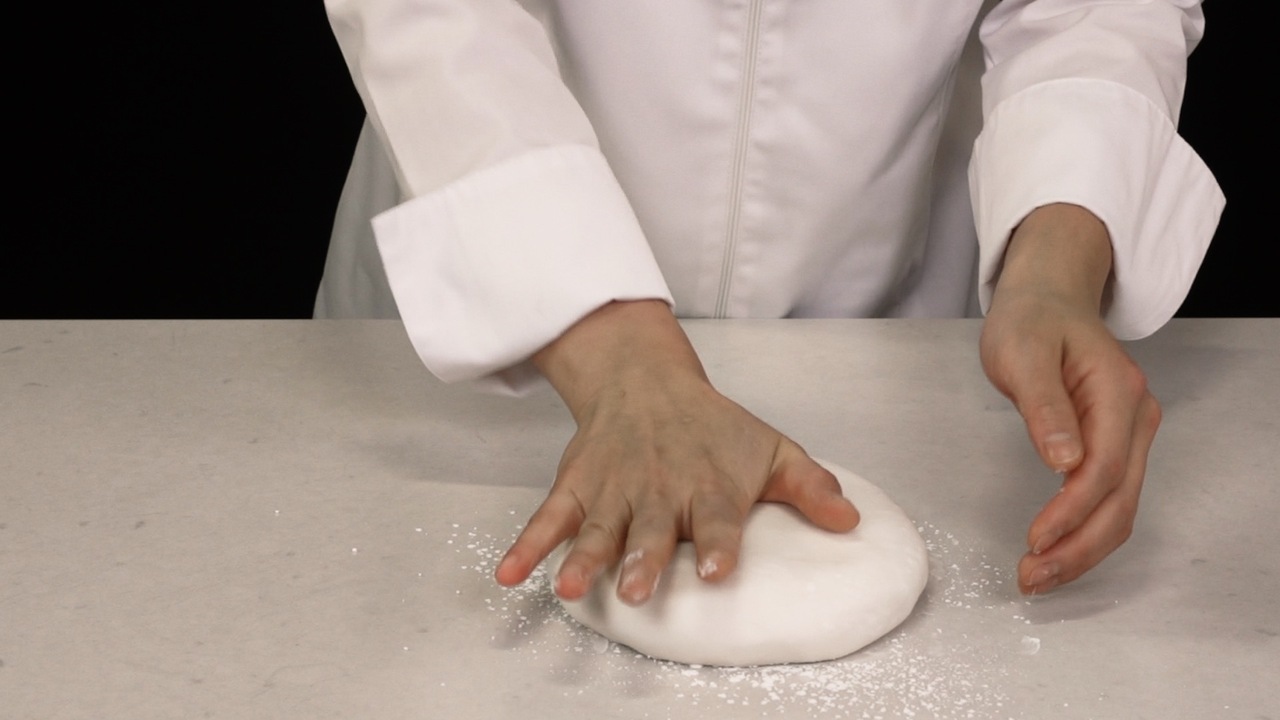
Lightly dust the work surface with confectioners’ sugar and gently knead the fondant. Form it into a ball with the smooth side up, then flatten with your hand.
Cover to prevent it from drying out.
2
Covering the Cake Drum
Ingredients
Vegetable shortening - As needed
600 g Fondant, desired color
Lightly apply shortening on top of the cake drum, making sure to spread it to the edge and set it aside.
Dust the work surface with confectioners’ sugar and place the fondant on top. Begin rolling from the center to the top and bottom. Alternate in both directions and use confectioners’ sugar to dust as needed. If there are air pockets, remove them with a straight pin as you are rolling.
Gently stretch the fondant into an oval shape. Then turn the fondant 90-degrees to the right. Lightly roll up and down to stretch it into a circle. Continue until the fondant is stretched to approximately 14 in (35 cm) circle and is about 3/16 in (0.5 cm) thick.
Position the cake drum slightly off to the side. Tuck your hands under the fondant and gently lift it off of the work surface. Place it on top of the cake drum. Secure it and smooth out any air pockets using a fondant smoother. Then trim the excess around the edge and smooth them out.
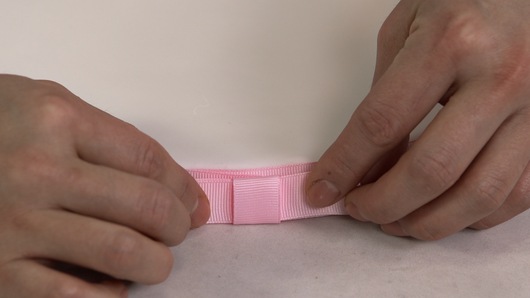
Measure the ribbon’s length around the cake drum and trim it about a ½ in (12 mm) longer. Beginning at the back of the cake, place small dots of hot glue on the side of the drum. Tightly secure the ribbon around and overlap the seams. Now cut two ribbon strips, one 6 in (15 cm) and the other 1 3/8 in (3.5 cm). Glue one end of the 6 in (15.2 cm) strip to form a circle. Glue it in the center to create a number 8. Wrap the 1 3/8 in (3.5 cm) strip around the center and glue it in the back. Attach it to cover the back ribbon seam.
3
Covering the Cake
Lightly dust the work surface with confectioners’ sugar and gently knead the fondant. Form the fondant into a ball with the smooth side up, then flatten it with your hand.
Begin rolling from the center to the top and bottom. Alternate in both directions and dust as needed. If there are air pockets, remove them with a straight pin as you are rolling. Then, gently stretch the fondant into an oval shape.
Then turn the fondant 90-degrees to the right. Lightly roll it up and down to stretch it into a circle. Continue until the fondant is stretched to an approximate 16 in (40 cm) circle and is about 3/16 (0.5 cm) of an inch thick. Lastly, smooth the rolling pin over the fondant to gently stretch it.
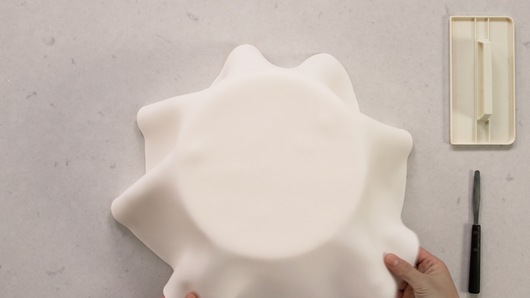
Position the cake slightly off to the side. Tuck your hands under the fondant and gently lift it off of the work surface. Place it over the cake. Secure the top and side around the top edge using your palm. Gently unfold the pleated fondant with one hand and smooth it out with the other hand without stretching it out, then adhere it to the side of the cake. Continue around the side until it is completely covered. Then trim the excess from the bottom. Gently smooth the side and bottom edge using two fondant smoothers.
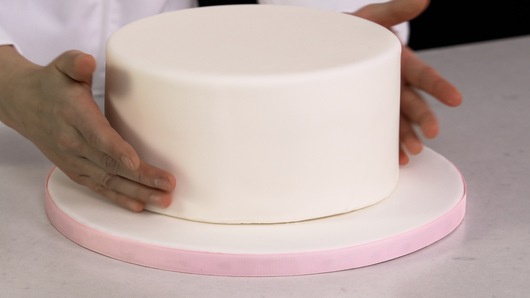
Place a few masking tape loops in the center of the cake drum and center the cake on top.
4
Storage & Shelf Life
Store rolled fondant, tightly wrapped twice in plastic, then place it into a plastic or vacuum-sealed bag with as much air removed as possible. Then put it into the refrigerator for up to 6 months. Allow it to come to room temperature and knead in shortening before use. Well-wrapped rolled fondant lasts for years in the freezer. Again, allow it to thaw and come to room temperature, then knead in shortening before use. Finally, use and re-freeze rolled fondant without any problems or ill effects on the paste.