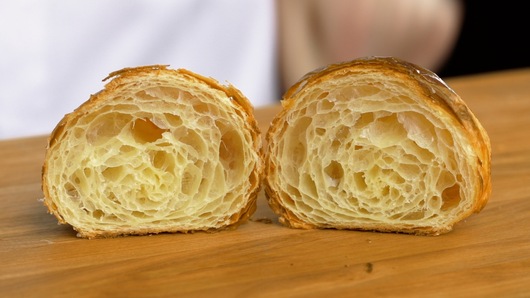
Croissants and Chocolate Croissants are buttery, flaky breakfast pastries made with yeast-leavened dough that incorporates butter through a succession of folds to create layers, a process called laminating. A croissant is traditionally shaped into a curved crescent, while a chocolate croissant, or pain au chocolat, is rolled around two chocolate batons in a rectangular shape. This recipe See Notes below for the equipment list.
Chef's notes
If the dough is rolled too short, the butter will be exposed, and the rolling pin will stick to it. Simply remove the wrapped butter book and roll the dough out longer. Use bread flour on the work surface as needed. If the dough is too long, it will overlap and produce an improper lamination. To correct this, slightly push in the dough.
Equipment:
Digital scale
Oven: convection, electric, or gas
Timer
Thermometer
Mixing bowl, medium
Rubber spatula, medium
Plastic wrap
Acetate, food-grade, full size, storage plastic bag (Ziplock) or plastic wrap
Rolling pin
Brush to dust table
Ruler
Proof box or closed cabinet
Stand mixer with hook attachment
Round dough scraper
Template, triangular and rectangular to cut croissants
Chef’s knife
Paring knife
4-Baking tray, lined with parchment paper
Pastry brush, medium
Cooling rack
Steps
1
Day 1 - The Poolish Starter & Détrempe Dough
Ingredients
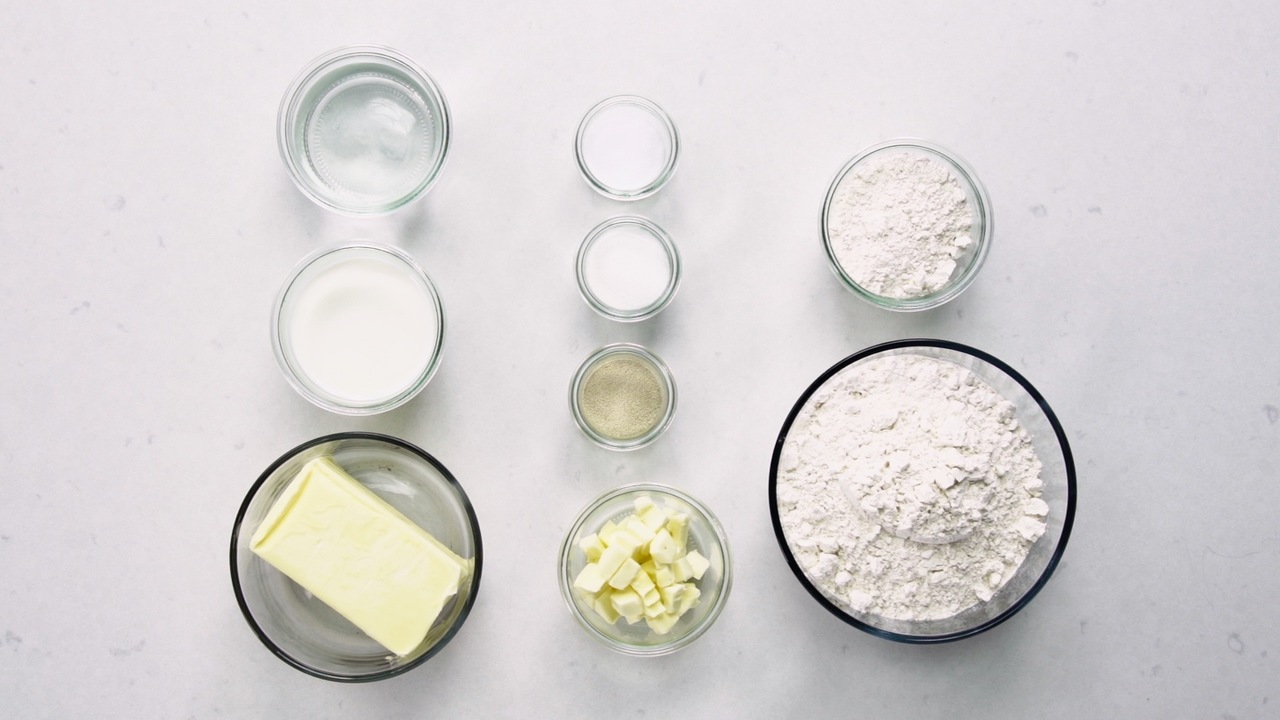
180 g Water
13 g Dry instant yeast or 32 g fresh yeast
135 g Bread flour
Calculate and adjust the temperature of the water to the required base temperature of 54ºC.
You are now ready to begin the poolish. Combine the yeast, water, and 135 grams of bread flour in a mixing bowl. Mix for 30 sec using a rubber spatula or until the poolish is well incorporated.
This will provide 328 grams total of poolish starter.
Cover the mixing bowl with plastic wrap, making sure it does not touch the poolish. Allow the poolish to sit at room temperature for approximately 45 min or until it doubles in volume.
2
Day 1 - Butter Book
Ingredients
460 g European-style butter, unsalted, 82% fat, for butter book
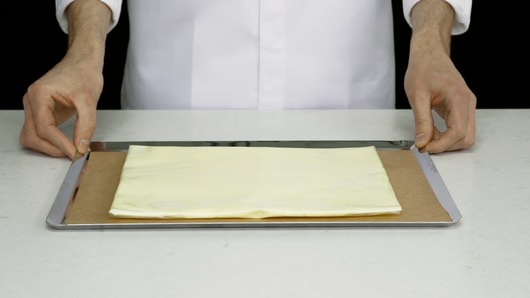
In the meantime, you can make the butter book. Take the 460 grams of butter and place it at one end of the full sheet of acetate, or heavy-duty plastic wrap. Fold the acetate in half to cover the butter. Flatten the butter in both directions using a rolling pin.
Remove the butter and place it back in the center of the acetate. Just as if you were making an envelope, fold in the top and bottom of the acetate. Then fold the right side and left side in towards the center. The final size of the book should be 10 in x 8 in (25 cm x 20 cm).
Flip the book over and roll on it, pushing the butter in all four corners with a rolling pin.
Now place it on a tray lined with parchment paper and put it in the refrigerator for at least 30 min or until firm.
3
Day 1 - Détrempe Dough
Ingredients
235 g Whole milk, 3.5% fat
50 g Granulated sugar
75 g Unsalted European-style butter, 82% fat, room temperature
16 g Fine sea salt or fine table salt
600 g Bread flour
328 g Total Poolish Starter
When the poolish is ready, you will see that it has doubled in volume and that it has some bubbles on the surface. This will confirm that the fermentation is active. You are now ready to mix the croissant dough détrempe.
Calculate and adjust the temperature of the milk to the required base temperature of 54ºC.
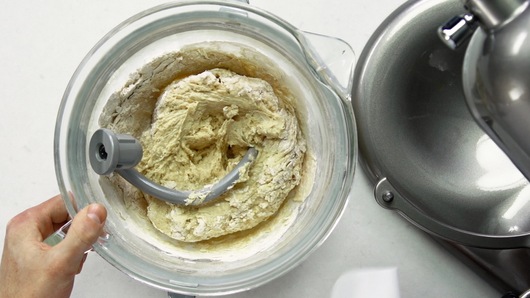
Gently, transfer the poolish to a stand mixer bowl and add the remaining ingredients, including the milk, sugar, soft butter, salt, and bread flour. Mix on low speed for 2 min using the hook attachment.
Stop the mixer and scrape down the side of the bowl. Continue to mix on low speed for 3 more minutes.
Then increase to medium speed and mix for 1 min. The consistency of the dough should be firm, but do not overmix. The final temperature of the dough should be 71-73ºF (21-23˚C).
Remove the dough from the mixer bowl and place it on the work surface.
Round the dough into a smooth ball and wrap twice, very tight with plastic wrap. Place it in the refrigerator overnight.
4
Day 2 - Rolling and Turning the Dough
Ingredients
24 pieces - Chocolate batons or dark chocolate chips
100 g Bread flour for dusting
1 recipe - Egg wash, prepared
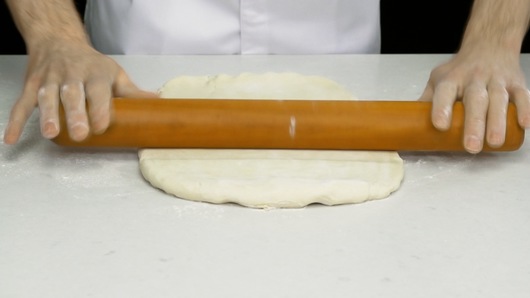
Now it is time to roll out the dough. Dust the work surface with bread flour and place the dough with the smooth side down. Flatten with your hands, and then dust the top with bread flour.
Start rolling the dough in a rectangular shape while always keeping the edges squared. Roll to 18 in (45 cm) x 10 in (25cm).
Place it on a tray lined with parchment paper and cover with plastic wrap to prevent the dough from drying out. Keep it in the refrigerator for 45 min. The dough should be firm to the touch.
Remove the butter book and the détrempe dough from the refrigerator. The butter and the détrempe dough should be equally firm, but pliable enough so that they bend. Put the wrapped butter in the center of the dough and fold the bottom edge to the center over the butter, and the top edge to the center. This will help gauge if the dough is at the proper length.
Now that it is at the proper length, unwrap the butter book and place it in the center. Gently press the butter with your hands to secure it. Fold the bottom and the top edges of the dough over the butter. To secure, gently tap the seam.
Lightly dust the work surface and the top of the dough with bread flour and turn the dough so that the seam is vertical.
Now begin rolling evenly from the top to the bottom. Alternate in both directions to ensure proper lamination. It is important to make sure the dough is rolled at the same thickness for its entire length. Roll evenly to 28 in (70 cm) long. Always check to make sure the dough does not stick to your rolling pin or to your work surface. If so, lightly dust with bread flour.
Fold the top of the dough to the center and fold the bottom of the dough over the top. This is called a single turn which will be your first “turn.”
Now it is time to repeat the same steps for the second turn. Make sure the seam is on the right side before you begin. Gently press 2 fingers on the dough to mark the two turns, making sure not to puncture the dough. Place it in the refrigerator for 60 min.
To complete the 3rd and final turn, make sure the seam is vertical and on your right side.
Again, repeat the same steps as the first two turns and roll evenly to 28 in (70 cm) long. Apply the 3rd turn, mark the dough and cover it with plastic wrap. Place it in the refrigerator for 60 min.
Then roll the dough to its final shape. Lightly dust the work surface and the top of the dough with bread flour. Turn the dough so that the seam is vertical and on your right side. Roll into a strip 8 in (20 cm) x wide 35 in (90 cm) long and 1/8 in (3 mm) thick.
5
Assemble and Bake
The dough can now be divided in half to make plain or chocolate croissants. To make plain croissants, cut the dough into 12 triangular shapes, 23⁄4 in (7 cm) at the base, and 8 in (20 cm) long using a chef’s knife. Each croissant should weigh 70 grams (2.5 oz).
Make a 5/8 in (1.5 cm) cut into the base edge using a paring knife.
Hold the dough by the base of the triangle above the work surface and slightly stretch the dough downwards towards the tip of the triangle.
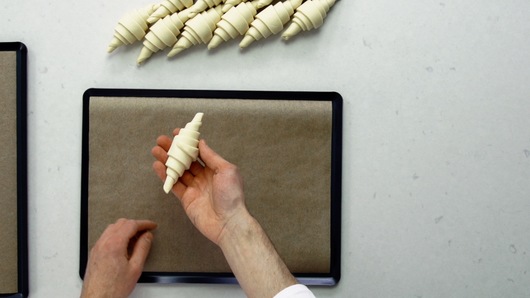
Next, place the triangle pieces on the work surface. At the base, gently stretch each corner from the center cut and make a small fold inwards towards the pointed edge. Now, place both hands on the croissant and gently roll the dough towards you.
Place six croissants per tray lined with parchment paper. Make sure the end tip is underneath the croissant; otherwise, it will curl away during the proofing process. Set aside.
To prepare the chocolate croissants, fold the remaining dough horizontally in half, making a crease and then unfold. Cut the dough along the crease.
Trim the edges of the dough and cut 6 strips, 3 in (7.5 cm) wide. Place 2 chocolate batons on the strip, 1 in (2.5 cm) from each end.
Fold the top edge over the chocolate and roll. Slightly press down to secure.
Prepare the proof box and set between 77-80ºF (25-26ºC).
Next, egg wash the plain croissants parallel to the croissant layers using a soft pastry brush, and then egg wash the chocolate croissants. Do not cover. The egg-washed croissants should now be placed in a proof box for 2 hrs or until they double in volume.
Once all of the croissants have been proofed, allow them to rest for 10 min at room temperature. In the meantime, preheat the oven to 360ºF (180ºC). Gently egg wash the croissants for a second time.
Bake the croissants for approximately 12 min. Slightly open the oven door for a full 2 sec to allow the steam to escape. Close the door and continue to bake for 4 min.
Transfer to a cooling rack and let cool for 15-20 min.
6
Storage
Storing & Shelf Life:
Croissants are best fresh or have a one-day shelf life at room temperature. Freeze raw croissants well covered with plastic wrap or in an airtight container. To defrost, transfer them wrapped into the refrigerator or leave at room temperature overnight. Once at room temperature, resume the proofing and baking process. Freeze baked croissants tightly wrapped in plastic or an airtight container for up to 1 month. To defrost, place them wrapped in the refrigerator overnight. Then unwrap and stagger them on a baking tray. Flash bake in a preheated 400°F (200°C) oven for about 2 minutes. Use day-old croissants to make almond croissants or croissants filled with a cooked savory filling.
2 Comments
Alana L•
Hi there! If I were to freeze the croissants, at which stage do I freeze them? I’m assuming once they’re shaped but please confirm. Thank you!
Alana, you can freeze raw croissants after they are shaped well covered with plastic wrap or in an airtight container. To defrost, transfer them wrapped into the refrigerator overnight. Bring to room temperature, and resume the proofing and baking process.