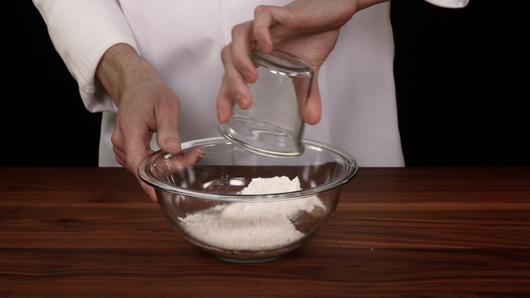
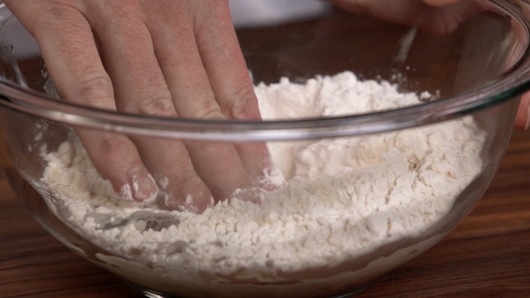
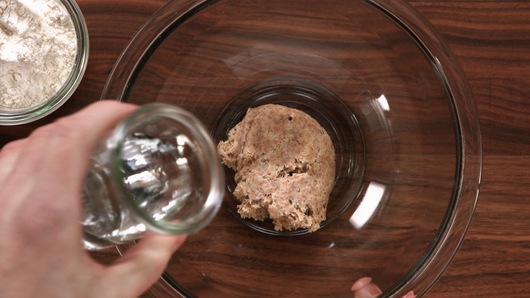
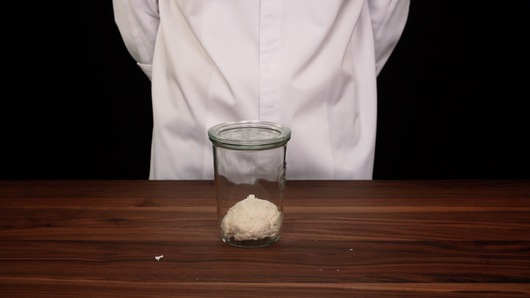
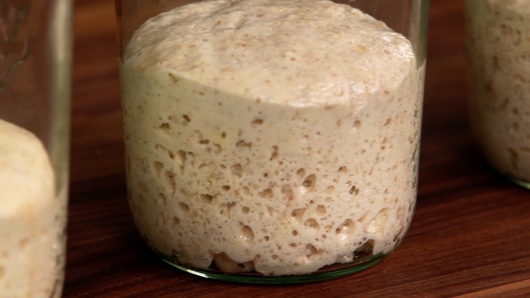
Some bread starters use naturally occurring yeasts and bacteria from flour and water. A living starter requires regular feedings for it to stay active. This recipe teaches the method of beginning the starter and how to keep it alive and active.
Resting Time: 12 to 24 hours over 5 days
Steps
1
Day 1: Making the Liquid Starter - Levain
Ingredients
100 g bread flour
100 g Rye flour
200 g Water
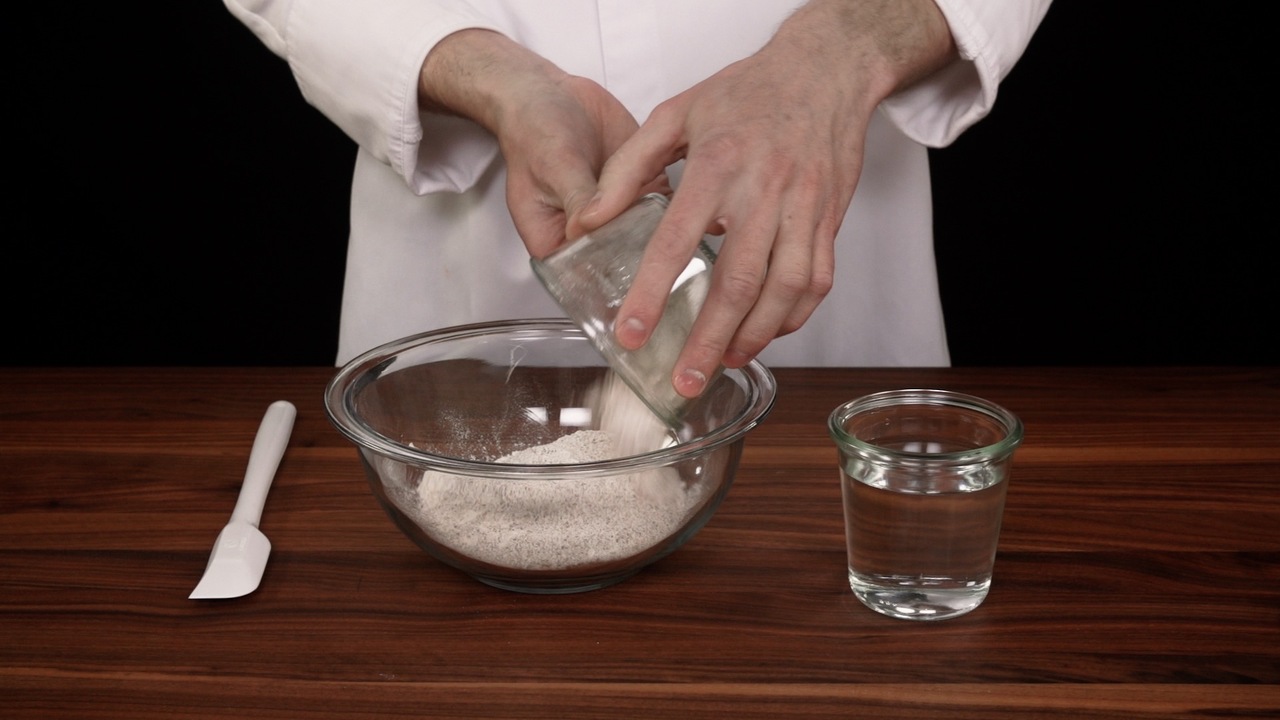
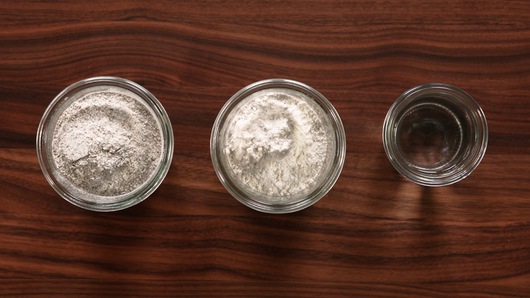
On the first day of a liquid starter, we mix rye flour, bread flour, and water. Rye flour contains many microorganisms that help accelerate the activity of the starter. Each day, we feed the starter with new flour and water. The rye flour is not added after day one, and this is why you will notice the color of the starter fluctuates from dark to light as the feeding progresses.
2
Step 2: Day 2 AM: Liquid Starter - Levain
Ingredients
100 g Bread flour
100 g Water
100 g Starter
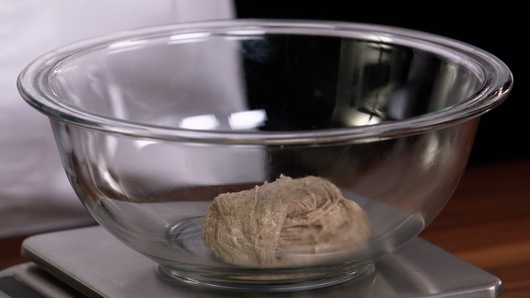
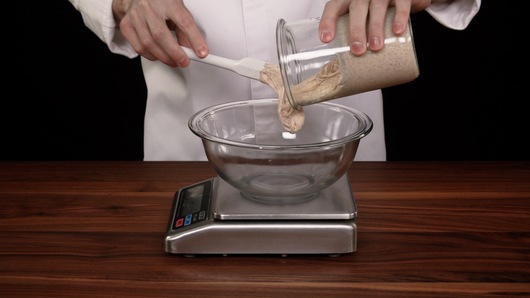
On day 2, remove 100 grams from the first mix and place it into a new bowl. This will become the starter. Discard the rest.
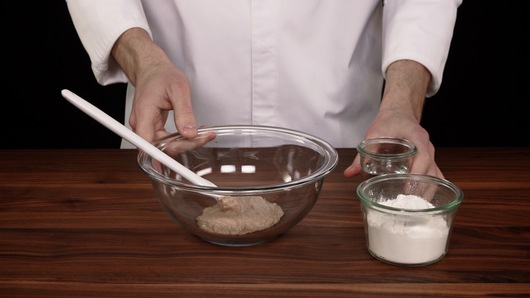
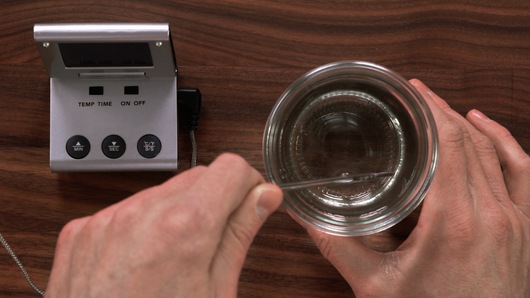
Calculate and adjust the temperature of the water to the required base temperature of 65˚C. Add it along with the 100 grams of bread flour from the day 2 AM list. Mix until it is well incorporated. The final temperature of the dough should be 73-77˚F or (23-25˚C). Cover and allow it to ferment in a warm place at 75-80˚F ((24-26˚C) for 12 hours.
3
Step 3: Day 2 PM: Liquid Starter - Levain
Ingredients
100 g Bread flour
100 g Water
100 g Starter
Remove 100 grams of the mix. Calculate and adjust the temperature of the water to the required base temperature of 65˚C. Add it along with the flour from the day 2 PM list. Mix it together until it is well incorporated. The final temperature of the dough should be 73-77˚F or (23-25˚C). Cover and allow it to ferment in a warm place at 75-80˚F(24-26˚C) for 12 hours.
4
Step 4: Day 3: Liquid Starter - Levain
Ingredients
100 g Bread flour
100 g Water
50 g Starter
On the third day, reduce the amount of starter to 50 grams. Calculate and adjust the temperature of the water to the required base temperature of 65˚C. Add it along with the 100 grams of bread flour from day 3. Mix until it is well incorporated. The final temperature of the dough should be 73-77˚F (23-25˚C). Cover and allow it to ferment in a warm place at 65-70˚F (18-21˚C) for 12 to 24 hours.
5
Step 5: Day 4: Liquid Starter - Levain
Ingredients
100 g Bread flour
100 g Water
25 g Starter
Repeat the process on day 4, while reducing the amount of starter to 25 grams. Add the flour and the adjusted water for day 4. The final temperature of the dough should be 73-77˚F (23-25˚C). Cover and allow it to ferment in a warm place at 65-70˚ (18-21˚C) for 12 to 24 hours.
6
Step 6: Day 5: Thereafter: Liquid Starter - Levain
Ingredients
100 g Bread flour
100 g Water
25 g Starter
Repeat the process on day 5 and every day thereafter, while reducing the amount of starter to 25 grams. Add the flour and the adjusted water. Cover and allow it to ferment in a warm place at 65-70˚F (18-21˚C) for 12 to 24 hours.
The liquid starter is now ready to use for breads like sourdough miche and ancient grain.
7
Step 7: Day 1: Stiff Starter
Ingredients
100 g Bread flour
100 g Rye flour
100 g Water
The method for a stiff starter is the same as the liquid starter. However, the ratio of water to flour is much less resulting in stiff dough.
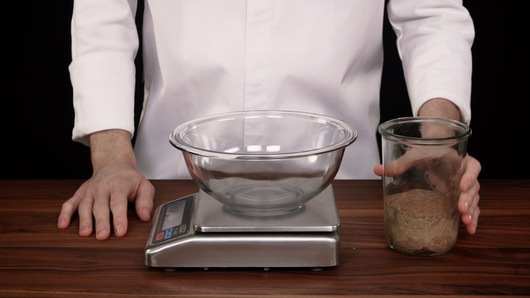
Scale the ingredients precisely and bring them to room temperature.
Calculate and adjust the temperature of the water to the required base temperature of 65˚C.
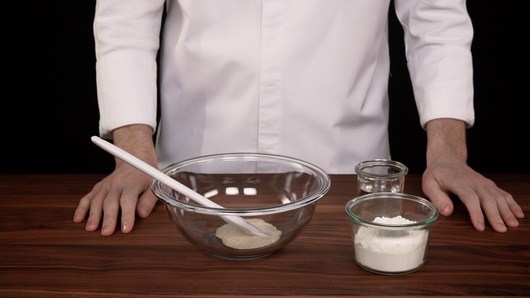
Combine the bread flour, rye flour, and water in a bowl. Mix until it is well incorporated. The final temperature of the dough should be 73-77˚F (23-25˚C). Cover and allow it to ferment in a warm place at 75-80˚F (24-26˚C) for 24 hours. The mixture should double in volume. If not, let it ferment for an additional 12 hours.
8
Step 8: Day 2 AM: Stiff Starter
Ingredients
100 g Bread flour
50 g Water
100 g Starter
On day 2, remove 100 grams from the first mix and place it into a new bowl. This will become the starter. Discard the rest.
Calculate and adjust the temperature of the water to the required base temperature of 65˚C. Add it along with the 100 grams of bread flour from day 2 AM. Mix until it is well incorporated. The final temperature of the dough should be 73-77˚F (23-25˚C). Cover and allow it to ferment in a warm place at 75-80˚F (24-26˚C) for 12 hours.
9
Step 9: Day 2 PM: Stiff Starter
Ingredients
100 g Bread flour
50 g Water
100 g Starter
Remove 100 grams. Calculate and adjust the temperature of the water to the required base temperature of 65˚C. Add it along with the flour from the day 2 PM list. Mix until well incorporated. The final temperature of the dough should be 73-77˚F (23-25˚C). Cover and allow it to ferment in a warm place at 75-80˚F (24-26˚C) for 12 hours.
10
Step 10: Day 3: Stiff Starter
Ingredients
100 g Bread flour
50 g Water
50 g Starter
On day 3, reduce the amount of starter to 50 grams. Calculate and adjust the temperature of the water to the required base temperature of 65˚C. Add it along with the 100 grams of bread flour. Mix until it is well incorporated. The final temperature of the dough should be 73-77˚F (23-25˚C). Cover and allow it to ferment in a warm place at 65-70˚F (18-21˚C) for 12 to 24 hours.
11
Step 11: Day 4: Stiff Starter
Ingredients
100 g Bread flour
50 g Water
25 g Starter
Repeat the process on day 4, while reducing the amount of starter to 25 grams. Add the flour and water for day 4. The final temperature of the dough should be 73-77˚F (23-25˚C). Cover and allow it to ferment in a warm place at 65-70˚F (18-21˚C) for 12 to 24 hours.
12
Step 12: Day 5: Thereafter: Stiff Starter
Ingredients
100 g Bread flour
50 g Water
25 g Starter
Repeat the process on day 5 and every day thereafter, while reducing the amount of starter to 25 grams. Add the flour and the adjusted water. The final temperature of the dough should be 73-77˚F (23-25˚C). Cover and allow it to ferment in a warm place at 65-70˚F (18-21˚C) for 12 to 24 hours.
13
Step 13: Storage
Shelf Life of a Liquid Starter
Refrigerate a liquid starter for five days without feeding it, then begin feeding after day 5. A liquid starter at room temperature around 75°F (24°C) has a shelf life of about 8 hours.
Shelf Life of a Stiff Starter
Refrigerate a stiff starter for seven days without feeding it, then begin feeding after day 7. A stiff starter at room temperature around 75°F (24°C) has a shelf life of about 6 hours.